If you’re thinking about buying a home in Southwest Florida—Naples, Fort Myers, Estero, Bonita Springs, or Cape Coral—one of the biggest questions you’ll hear is:
“Is it in a flood zone?”
And right behind that:
“How much is flood insurance?”
Let’s break this down in simple terms, because there’s a lot of confusion and misinformation around this topic.
First: Every Property Is in a Flood Zone
This surprises many buyers coming from Minnesota and other Midwest states.
There is no such thing as a property that is “not in a flood zone.”
Every property is assigned a flood zone by FEMA. The difference is simply whether the risk is low, moderate, or high.
How Flood Zones Work
Flood zones are determined based on several key factors, including:
- Elevation
- Proximity to water such as the Gulf, canals, lakes, or rivers
- Storm surge risk
- Rainfall and drainage patterns
These are shown on what is called a Flood Insurance Rate Map (FIRM), which lenders and insurance companies use when evaluating a property.
How to Check the Flood Zone for Any Property
Before buying a home, you can check the flood zone yourself in less than a minute.
Use this official tool from FEMA:
https://msc.fema.gov/portal/search
Enter the property address and you will see:
- The flood zone designation (X, AE, VE, etc.)
- Map details
- Risk level
This is the same tool used by lenders and insurance companies, making it the most reliable source.
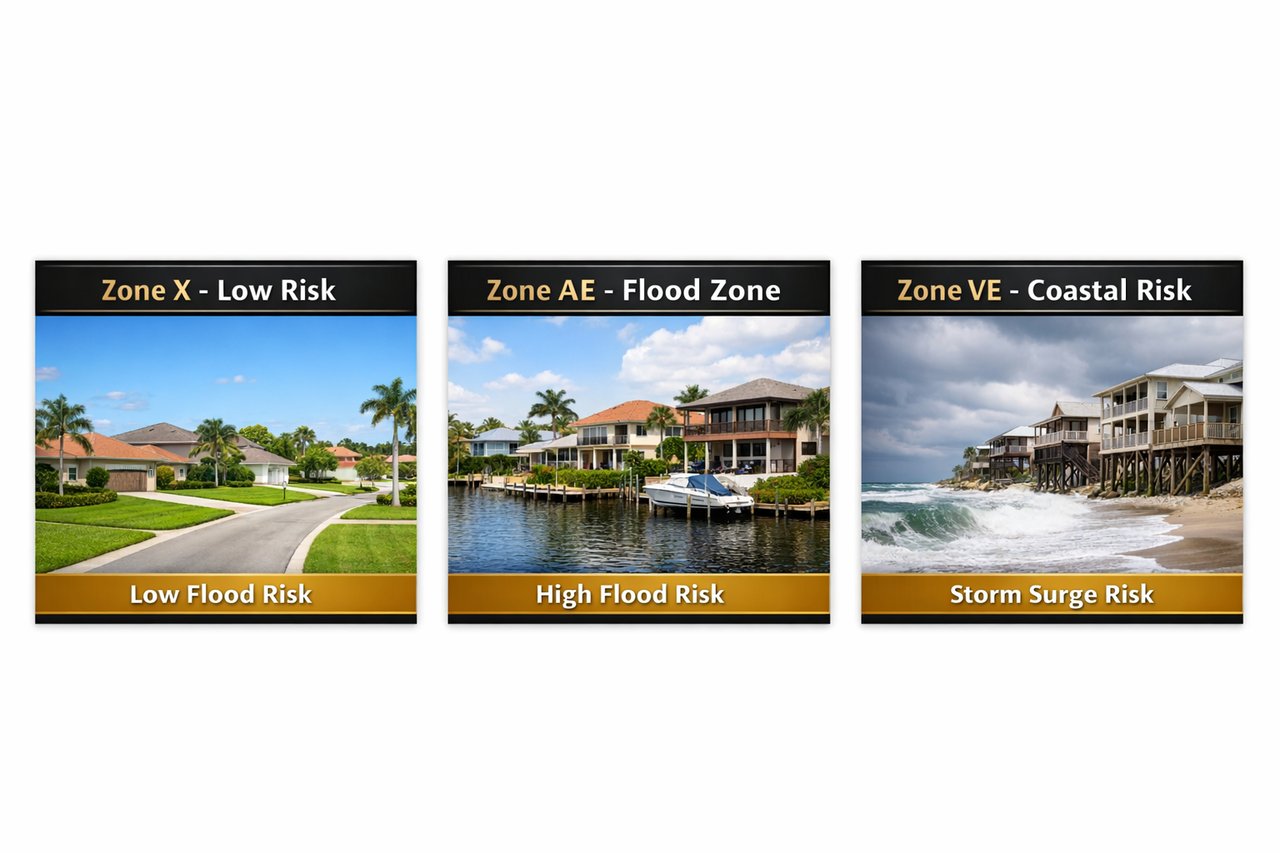
The Three Main Flood Zone Types in Southwest Florida
Zone X (Low to Moderate Risk)
Zone X is the lowest-risk category and typically the most desirable for buyers.
- Flood insurance is not required by lenders
- Insurance is optional and usually lower cost
- Common in higher elevation or inland areas
Even in Zone X, flooding can still occur, so some buyers still choose to carry coverage.
Typical cost range: approximately $300 to $700 per year
Zone AE (High Risk – Inland Flooding)
Zone AE is very common throughout Southwest Florida.
- 1 percent annual flood chance (often called the 100-year flood zone)
- Typically located near canals, lakes, or low-lying areas
- Base Flood Elevation (BFE) is established
- Flood insurance is required when financing
Typical cost range: approximately $1,000 to $2,000 per year, depending on the property
It is important to note that two homes on the same street can have very different flood zones and insurance costs.
Zone VE (Coastal High Risk)
Zone VE represents the highest-risk areas.
- Located near the Gulf with exposure to storm surge and wave action
- Often requires elevated construction
- Flood insurance is required
- Insurance costs are the highest
Typical cost: $2,000 per year and up, sometimes significantly higher depending on the home
When Is Flood Insurance Required?
Flood insurance is required when:
- The property is financed with a mortgage
- The home is located in a high-risk flood zone (A or V zones)
If a buyer is paying cash, flood insurance is optional, although many still choose to carry it for protection.
What Flood Insurance Covers
Flood insurance is separate from a standard homeowner’s insurance policy.
It typically covers:
- Structural components such as walls, flooring, electrical, and plumbing
- Major systems such as HVAC and water heaters
- Limited personal property
Standard homeowner’s insurance policies do not cover flood damage.
How Much Does Flood Insurance Cost?
Typical ranges in Southwest Florida:
- Zone X: around $600 per year
- Zone AE: approximately $1,000 to $1,500 per year
- Zone VE: $2,000 per year and higher
Actual costs vary significantly depending on elevation, construction, age of the home, and other factors.
Why Flood Zones Have Changed
Following recent hurricanes, flood maps have been updated throughout Southwest Florida.
Some properties have been reclassified into higher-risk zones, which can impact insurance requirements and costs.
This is an important reason to review flood zone information carefully during the home search process.
Key Tips for Buyers
- Do not rely solely on whether a property is in a flood zone; focus on the actual insurance cost
- Use the FEMA lookup tool early in your home search
- Obtain multiple insurance quotes, as pricing can vary significantly
- Consider resale implications, as lower-risk zones tend to appeal to a broader pool of buyers
Final Thoughts
Flood zones are often misunderstood. They are simply a way to classify risk.
There are many desirable homes located in higher-risk zones, and there are also properties in lower-risk zones that have experienced flooding.
The key is understanding the risk and factoring it into your decision.
Thinking About Moving from Minnesota to Florida?
Flood zones and insurance are one of the biggest differences buyers encounter when relocating.
If you are considering a move or a second home in Florida, I can help you:
- Evaluate flood zones on specific properties
- Estimate insurance costs before making an offer
- Navigate the process with clarity and confidence
A smarter move from Minnesota to Florida starts with understanding the details, and this is one of the most important ones.