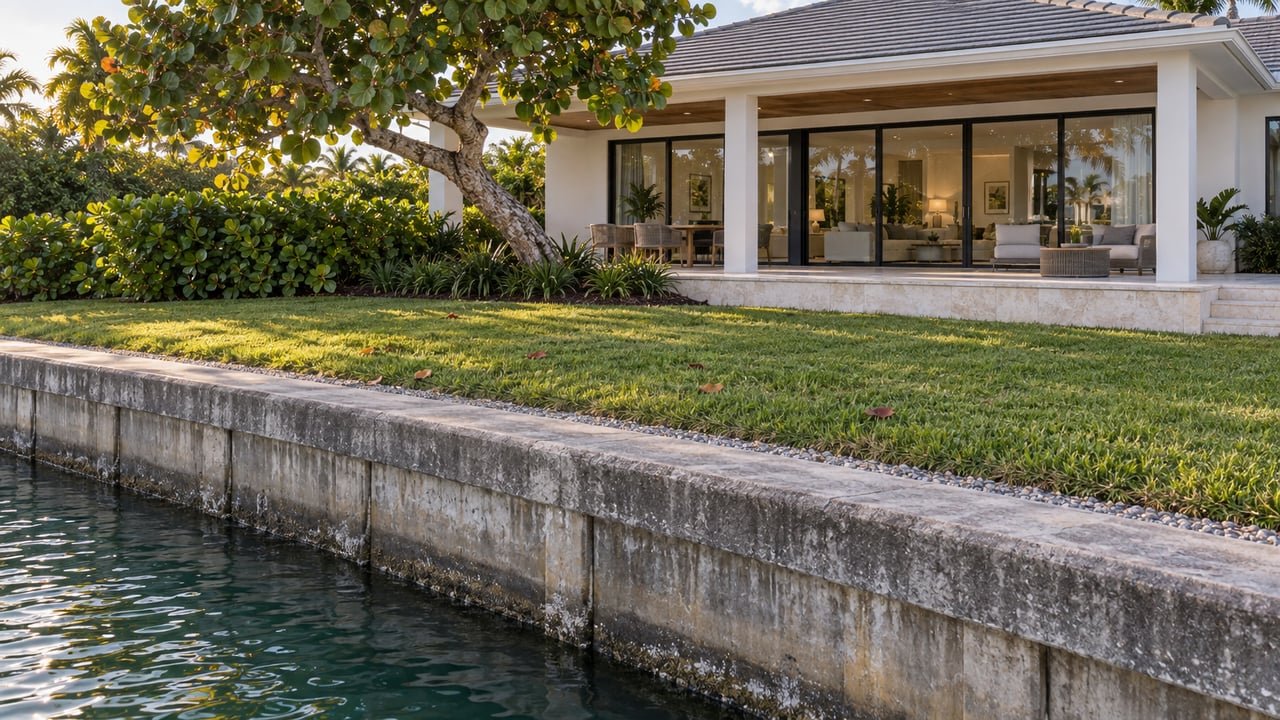
A marine contractor standing on a Cape Coral dock does the same walk every time. Tap the cap for a hollow sound. Look for a gap opening up between the seawall and the yard behind it. Check the weep holes for blockage. Feel for movement in the tiebacks when a boat wake hits the wall. None of that tells you what you actually need to know before you list a canal-front home.
What matters more than any single crack is which side of one city line the fix falls on. Cape Coral's own rules split every seawall job into two categories, and those two categories carry different costs, different design requirements, and different timelines. Most sellers don't find out which category they're in until a marine inspection tells them, and by then they're pricing a listing around a number they didn't choose.
What the 2022 Standard Actually Draws a Line Around
In March 2022, the City of Cape Coral adopted new engineering design standards for seawalls under Ordinance 85-21. A notice to industry later clarified exactly how far that standard reaches: any new seawall, or any portion of an existing seawall that gets replaced, has to meet the 2022 standard. Repairs to a current seawall do not have to meet it, as long as no portion of the wall is actually being replaced.
That single distinction is the whole ballgame for a seller. A wall built in the 1990s that just needs a crack injected or a cap patched can be repaired to the older, looser standard it was originally built under. The same wall, if a contractor determines a section of panel has to come out, gets rebuilt to a stricter 2022 spec instead, on that section at minimum. Same canal, same age of wall, two entirely different projects depending on what the inspection finds.
Two Price Tiers Hiding Inside One Search Term
Search "Cape Coral seawall cost" and you'll find numbers that look contradictory. Some sources quote $100 to $300 per linear foot. Others quote $400 to $900 or more. Read closely and the contradiction resolves: those aren't competing estimates of the same job. They're describing two different jobs.
| Repair (no portion replaced) | Replacement (any portion replaced) | |
|---|---|---|
| Governing standard | Not required to meet the 2022 design standard | Must meet the City's 2022 Engineering Design Standards under Ordinance 85-21 |
| Typical work | Crack injection, cap patching, clearing weep holes, tightening tiebacks | New panels, new cap, new anchoring, full or partial rebuild |
| Reported cost range | Roughly $100 to $300 per linear foot | Roughly $400 to $900+ per linear foot |
| Permit review | Still permitted, generally a narrower scope | Structural, environmental, and zoning review together |
On an average 80 to 100 foot lot, that gap is the difference between a repair bill in the low five figures and a replacement bill that can land well into six. It's also why two neighbors with walls of similar age can get wildly different quotes. One wall stays in the repair tier. The other tips into replacement.
Where the Line Moves on You
The phrase that decides everything is "any portion of the existing seawall being replaced." That threshold is lower than most homeowners assume. A bulging section that looks like a candidate for a simple patch can turn out, once a contractor gets behind the cap, to need the panel itself pulled and replaced rather than sealed. The moment that happens, the project moves out of the repair tier and into the replacement tier, and the 2022 design standard applies to whatever portion is being rebuilt.
This is the part that catches sellers off guard mid-listing. A wall assessed as a minor repair in one conversation can be reassessed as a partial replacement in the next, once a contractor actually opens up the section in question. The cost estimate a seller had in hand a week earlier no longer applies, and neither does the permit path.
Permits Don't Run on the Same Clock as a Contract
Seawall work in Cape Coral isn't a single permit. It requires both structural review and environmental and zoning department review, and that combined process typically runs 10 to 20 business days. Dock and boat lift work tied to the same waterfront gets reviewed separately, for setbacks and navigation clearance, adding another layer if a lift or dock sits near the section in question.
A standard home sale contract doesn't leave that much room. If a buyer's inspection period surfaces a seawall issue for the first time, the seller is now negotiating repairs or credits against a permit timeline that may not close before the deal is supposed to. That mismatch, not the seawall itself, is usually what stalls or reopens a transaction.
What a Canal-Front Seller Can Actually Control
The one thing a seller controls is when this conversation happens, not whether it happens. A few things worth doing before a home goes on the market:
- Get a marine assessment before listing, so the repair-versus-replacement question gets answered on your timeline instead of a buyer's inspector's.
- Ask the assessor directly which tier the recommended work falls into, since that answer determines both the budget and how the listing gets priced.
- If a section looks borderline, get that finding in writing. A documented assessment you commissioned carries more weight in a negotiation than a surprise a buyer's inspector introduces two weeks into a contract.
- Keep weep holes clear. Those small openings exist to relieve hydrostatic pressure behind the panels, and when they get blocked by sediment or marine growth, pressure builds in ways that can push a wall from the repair tier toward the replacement tier over time.
- Know your material and age. Concrete seawalls are generally engineered for 30 or more years of service, vinyl for 50 or more, so material and install date give a rough sense of where a wall sits before an inspector ever shows up.
This week marks four years since Hurricane Ian came ashore in Southwest Florida, and plenty of the canal system's older walls were already decades into their service life when that storm tested them. That history is part of why the repair-or-replacement question isn't hypothetical for a lot of Cape Coral sellers this year. It's the first real conversation a listing needs to have.
A Few Questions Worth Settling Early
Do I have to fix a seawall before I can sell? Whichever tier the needed work falls into, along with its cost and timeline, becomes part of what buyer and seller work out in the contract.
How do I find out which tier my seawall falls into? A licensed marine contractor or engineer can assess the wall and state directly whether the recommended work counts as a repair or a replacement under the city's standard. That assessment is the single most useful document a seller can have before listing.
If you're weighing when to list a canal-front home in Cape Coral, Comstock & Company can walk through what a marine assessment is likely to turn up and how it fits into your pricing and timeline before a buyer's inspector finds it first. Let's Connect.
This article is general information, not legal, tax or financial advice. Consult a qualified professional about your situation.